
If you are a holder of a driving license issued abroad who is living in Spain, this post is for you. You are about to discover how to move to a Spanish driving license step by step.
We will explore which documents you must submit, where you should carry out the procedure, how long it actually takes, and some extra tips that will be very useful in order to avoid losing time.
Key takeaways
- Who can exchange: holders of a licence from the EU, the EEA or a country with an agreement with Spain, such as Argentina, Colombia, Morocco, the UK or Japan.
- Deadline: once you are a legal resident, you can drive with your foreign licence for 6 months; after that, you need to exchange it.
- Requirements: be a resident in Spain and hold a valid, non-suspended licence obtained before you got your Spanish residence.
- How it works: since May 2025 the exchange is done online through the DGT; you only visit Traffic when you are given a date to hand in your licence.
- Driving test: A1, A, B and EB licences are usually exchanged without a test, although some countries do require one.
Content
ToggleIs my driving licence valid in Spain?
To answer this question, we must first make an important distinction. And that’s because it depends on whether you are a member of a European Union country or a non-EU citizen.
On the one hand, EU and European Economic Area citizens (Iceland, Liechtenstein, and Norway) are allowed to use their home-country driving license within Spanish territory.
In other words, their licenses are valid in Spain, although with a nuance: they must be over the minimum age required to drive a vehicle in Spain (which is 18 years old).
However, if you are applying for an EU registration certificate to stay in the country for the long run, it is much better to exchange it for a Spanish driving license as soon as possible, as the process is really simple.
You just need to make sure that the license hasn’t expired in order to successfully exchange it.
And what about citizens from outside the European Union?
Their original license will not be valid. They can’t use their existing one.
However, Spain has agreements with countries all over the world to make it relatively easy to exchange a driver’s license. Thus, the first thing a foreigner who wants to drive in Spain must do is check whether her country of origin (where the license was obtained) is indeed one of those included in the list.
If it is, green light for the exchange.
Do you have any questions? Ask our immigration lawyers anything:
Which countries can exchange their driving license in Spain?
We are talking about Argentina, Bolivia, Brazil, Chile, Colombia, Dominican Republic, Ecuador, El Salvador, Guatemala, Nicaragua, Panama, Paraguay, Peru, Uruguay, Venezuela, Morocco, Tunisia, Turkey, Algeria, Philippines, Macedonia, Serbia, and Ukraine.
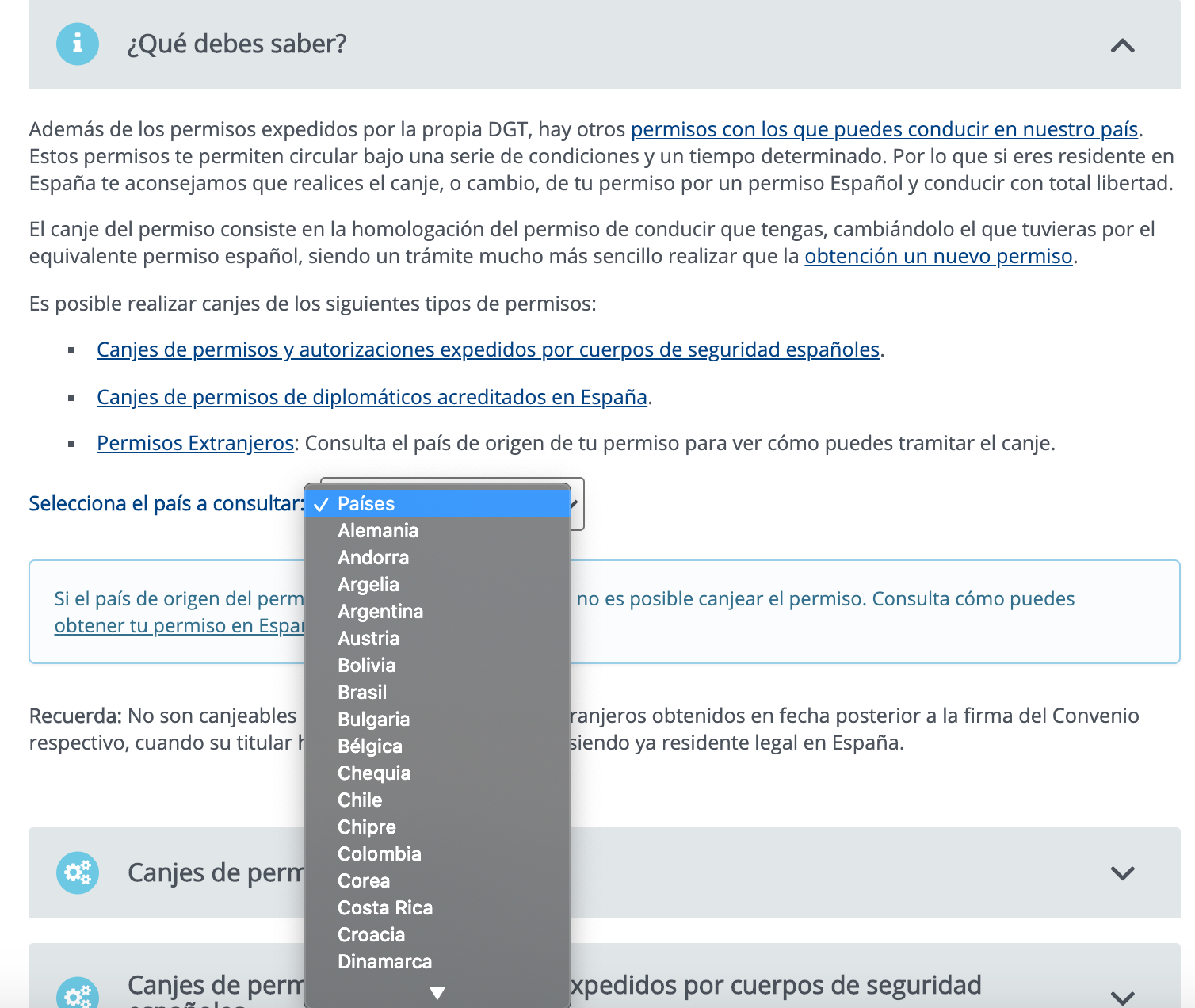
Alternatively, you can check if yours is included in the list by entering this link.
In the selector menu (as indicated in the screenshot below), you can check whether your country is listed or not.
If the country is on the list, you can formalize the procedure (which we will explain below).
Do I have to take a test to redeem my license?
Depending on your country of origin and the type of permit, this may be the case.
Generally, permits for classes A1, A, B, and EB do not require any kind of test, and the exchange occurs automatically after all the required documentation is provided.
However, there is a list of specific countries that do require an extra exam.
Are all licenses exchangeable?
No. You must be very careful because not all permits are redeemable, even if your country is on the list of countries with an agreement.
First of all, if the driving license was obtained after the agreement between both countries was signed and the foreigner already got its residency in Spain, then the process is not possible.
In other words, only those permits obtained prior to obtaining residence in Spain are exchangeable.
Furthermore, if the permit was exchanged in a country other than Spain and that country does not have an agreement, then the exchange will not be permitted in the Spanish territory either.
Therefore, you must be very careful with the specific situation you are in.
Requirements to exchange your driving license
During the first 6 months of your legal residence in Spain, you will be able to use your original license, the one you got in your home country.
However, once this period expires, you will have to process the exchange to a Spanish one.
What are the requirements you will have to meet?
- Be a resident in Spain
- Your driver’s license must be valid at the time of the exchange
- It cannot be suspended, restricted, or canceled
- Your driver’s license must have been obtained before you became a resident in Spain (that is, you obtained it before obtaining your TIE)
- You must not hold another licence of the same class issued in another EU or EEA country
Process to redeem your driver's license
Since May 2025, the DGT has simplified this procedure with the so-called digital exchange. If your country has a bilateral recognition agreement with Spain (such as Argentina, Japan, the United Kingdom, or Switzerland, among others), you can start and complete almost the entire process online, without making an appointment at the beginning.
This is how the procedure works today:
1. Digital exchange (the usual route for class A and B permits)
You access the DGT Electronic Headquarters with Cl@ve, digital certificate, or authorizing a representative through the Registry of Powers of Attorney. You upload your documentation in PDF, pay the corresponding fee online, and the DGT verifies the validity of your permit with the authorities of your country of origin (this step may take weeks, depending on the country).
When your application is approved, you receive a notification with the day and time to go to the Traffic Headquarters: only then do you need to present yourself to hand in your original card and collect your provisional authorization. You do not have to manage that appointment yourself: it is assigned directly to you by the system when approving the request.
2. In person
If you do not have Cl@ve or a digital certificate, or your exchange corresponds to a professional category (C, D) that may require practical proof, the procedure is carried out in person at the Traffic Headquarters, and in that case you do need to request an appointment in a traditional way
If you choose to do the whole process in person, the first step is getting an appointment with the DGT and handing in all the necessary documents.
Once you hand in all the documents and your original licence, you will be given a provisional driving authorisation, which you can use until your definitive Spanish licence arrives at your home by post, in approximately a month and a half. In the meantime, always carry your TIE or Spanish ID card with you while driving.
If you can’t attend by yourself, you can always designate a representative to do the paperwork for you (and deliver all the documentation). In that case, you will have to present extra paperwork: a document authorizing him/her to formalize the arrangements on your behalf (in addition to presenting their ID).
What if I need to make an appointment traditionally?
If your case comes in person (without Cl@ve/digital certificate, or professional category), you can request an appointment by calling 060 or through the DGT website, selecting your province and the procedure.
Keep in mind that, as this is a less common case, the availability of appointments may vary depending on the Headquarters. If your province has little availability, you can also consult appointments at headquarters in nearby provinces.
Which documents should I submit?
Whether you are going to process the digital exchange or do it in person, the first step is to gather all the necessary documentation.
- Your home-country driver’s license and a copy of it
- Legality certification (historic showing how long you have had the license, if you made any renewals, when, etc.). It must be legalized.
- Valid passport and copy
- Certificate of registration (“empadronamiento”)
- Residence card in Spain (valid) or Spanish DNI
- Medical certificate (with vision and hearing tests) with a favorable resolution. You must go to a medical center associated with the DGT to get your psychophysical aptitude report. This usually has a cost of 25-60€.
- Your residency history, which you can get at the immigration office (you’ll need to make an appointment beforehand).
- Official application form, printed and filled out (you will be given it on the day of the appointment so that you can fill it out).
- The fee to be paid, which is € 28.87 (if you must take an extra practice test, then the amount is € 94.05). This fee can be paid online at the DGT’s website, by credit card at the traffic headquarters, or at any financial institution
- Original passport photos, which must be 32x26mm, in color, and with a plain background.
Keep in mind that when you hand over the old license they will keep it and won’t give it back to you.
Can I drive while waiting for the exchange?
Yes, but with nuances.
While your digital exchange request is in process, you can continue circulating with your foreign permit. However, the moment you hand in your original card at the Headquarters, you are no longer able to use it: from then on you circulate with the provisional authorization that they give you that same day, valid while your definitive Spanish permit arrives.
How long does it take to redeem it?
The deadline now depends mainly on verification with your country of origin and the workload of your Traffic Headquarters, not on getting an appointment.
As a guide: online validation usually takes about 2-6 weeks for countries without additional verification, and up to 4-12 weeks if your country requires special checks.
Once your original card has been approved and delivered to the Headquarters, you receive your provisional authorization at the time, and the final physical card usually arrives by mail within a period of 1 to 3 months.
Start your change to the Spanish driving license now
Do you still have doubts or would you like our team of lawyers to help you out?