
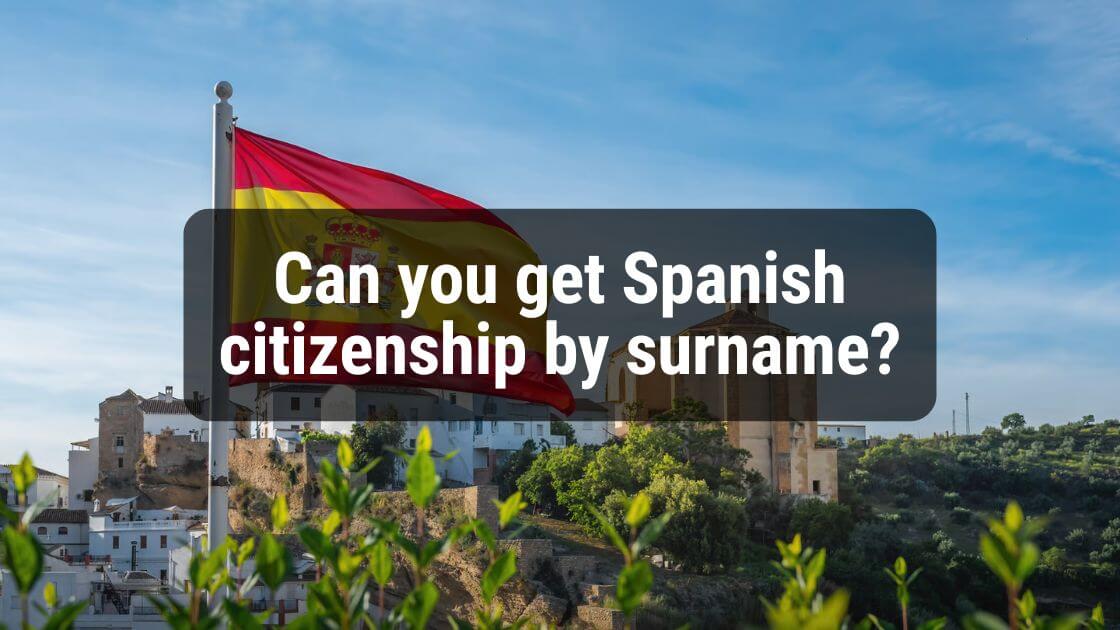
A single part of your name could indicate that you have Spanish roots, roots so strong that you might be able to apply for Spanish citizenship… your surname!
But can you really acquire Spanish nationality through your surname? Having a surname of Spanish origin alone may not be enough.
In the following article, we’ll explain everything in single terms: from how to legally obtain Spanish nationality to frequently asked questions about the relationship between your surname and nationality in Spain.
Key takeaways
- Surname and citizenship: your surname alone does not give you the right to Spanish citizenship; it may suggest a link to Spain, but you need a legal justification and documented descent.
- Origin of the myth: it comes from the Sephardic Law (12/2015) and the Democratic Memory Law (20/2022), aimed at specific groups, and from online surname lists that were never official and have no legal validity.
- Closed routes: the Sephardic Law no longer accepts applications, and the Democratic Memory route closed to new applications after 22 October 2025.
- By residency: 10 years of legal, uninterrupted residence, reduced to 2 for people from Equatorial Guinea, the Philippines, Portugal, Andorra or some Latin American countries, to 5 for refugees and to 1 if married to a Spaniard.
- By option: meant for foreigners with a parent born in Spain or with Spanish nationality, or who have been under the parental authority of a Spanish person.
- Spanish grandparent: having a Spanish grandparent does not automatically give you nationality: it depends on the applicable legal route, and you must prove the chain of descent with the full birth certificates of each generation.
Content
ToggleDoes your surname give you the right to Spanish citizenship?
No, your surname does not give you the right to Spanish citizenship by itself. However, it can mean that you fall into one of the categories that can grant you Spanish nationality.
There is a common belief that your surname gives you the right to apply directly for Spanish citizenship because of historical relations.
Many years ago, the Latin American community thought that the simple fact of having a Spanish surname (of the ones collected in an online list that we will talk about later) gave you the instant right to a Spanish passport.
As positive as it seems, this belief was not true at all.
The Spanish government has stated that, while a Spanish name or surname can mean there is a real relation with the country, there must be a legal justification to get a Spanish passport. Much more than a single surname.
Where the myth of “Spanish citizenship by surname” comes from
The myth of acquiring Spanish citizenship only by having a Spanish surname comes from a law passed in 2015 (Law 12/2015), as well as from a law passed in 2022 (Law 20/2022); both from the Spanish legal system.
Although both laws made it easier for certain groups to acquire Spanish nationality, neither of them established that a surname alone grants the right to citizenship.
How does this work?
Sephardic Law
Law 12/2015, commonly known as the Sephardic Law, allowed Sephardic Jews of Spanish origin, that is, descendants of the Jews expelled from the Spanish kingdoms following the Edicts of Expulsion of 1492, to apply for Spanish nationality without having to reside in Spain. The application period remained open until September 1, 2021.
However, eligibility under this law did not depend solely on having a surname of possible Spanish origin.
Applicants were required to provide documentary evidence of their Sephardic ancestry, demonstrate a special connection to Spain, and meet additional legal requirements, including passing Spanish language and constitutional and cultural knowledge exams, except in the cases exempted by law.
During the implementation of this procedure, numerous lists of purported Sephardic or Spanish (which are in the table below) surnames began circulating online.
Democratic Memory Law
Law 20/2022, commonly known as the Democratic Memory Law, has a completely different purpose. Its primary objective is to recognise and provide reparation for the victims of the Spanish Civil War and the Franco dictatorship.
Within this law, the Eighth Additional Provision allows certain individuals to apply directly for Spanish nationality, including:
- People born outside Spain whose father, mother, grandfather, or grandmother was originally Spanish and lost or renounced Spanish nationality as a consequence of exile.
- Children born abroad to Spanish women who lost their nationality after marrying a foreign citizen before the Spanish Constitution of 1978 entered into force.
- Adult children of individuals who previously acquired Spanish nationality under Spain’s earlier Historical Memory legislation.
In this case, the confusion arose because the beneficiaries are descendants of Spanish citizens and, naturally, often inherited their ancestors’ surnames. Over time, some people incorrectly assumed that the surname itself was what made them eligible for Spanish nationality, when in reality the law requires applicants to document their family relationship and descent from a qualifying Spanish ancestor.
Although Law 20/2022 does not mention surnames as a requirement, the coexistence of both laws and the widespread circulation of incomplete or misleading information online helped spread the belief that there is such a thing as “Spanish citizenship by surname.”
Spanish surname list
Here’s the tentative list of surnames that were thought to be direct paths to obtain Spanish citizenship:
| A | Aguilar, Alonso, Álvarez, Arias |
| B | Benítez, Blanco, Bravo |
| C | Caballero, Cabrera, Calvo, Campos, Cano, Carmona, Carrasco, Castillo, Castro, Cortés, Crespo, Cruz |
| D | Delgado, Díaz, Díez, Domínguez, Durán |
| F | Fernández, Ferrer, Flores, Fuentes |
| G | Gallego, García, Garrido, Gil, Giménez, Gómez, González, Guerrero, Gutiérrez |
| H | Hernández, Herrera, Herrero, Hidalgo |
| I | Ibáñez, Iglesias |
| J | Jiménez |
| L | León, López, Lorenzo, Lozano |
| M | Marín, Márquez, Martín, Martínez, Medina, Méndez, Mendoza, Molina, Montero, Mora, Morales, Moreno, Moya, Muñoz |
| N | Navarro, Nieto, Núñez |
| O | Ortega, Ortiz |
| P | Parra, Pascual, Pastor, Peña, Pérez, Prieto |
| R | Ramírez, Ramos, Reyes, Rivera, Rojas, Román, Romero, Rubio, Ruiz |
| S | Sáez, Sánchez, Santiago, Santos, Sanz, Serrano, Silva, Soto, Suárez |
| T | Torres |
| V | Vargas, Vázquez, Vega, Velasco, Vicente, Vidal |
Many of these compilations were based on historical, genealogical, and linguistic research conducted by specialists in the history of Hispanic Jewry and by institutions dedicated to the study and preservation of Sephardic heritage, including organisations such as the Institute Arias Montano and other cultural and genealogical associations.
These lists have informative and research value for individuals exploring a possible Sephardic family background, but they have no legal validity and have never been recognised as official lists by the Spanish Government.
This is where the myth began.
Many people mistakenly assumed that having a surname appearing on one of these lists was enough to qualify for Spanish citizenship, even though the law never created such a right.
Legal pathways to obtain Spanish nationality if you have a Spanish surname or ancestry
While we’ve already established that obtaining Spanish nationality solely through your surname isn’t possible, it is possible through ancestry, or if, thanks to that surname combined with other requirements, a connection to Spain can be demonstrated.
Obtaining Spanish nationality is a very simple process that requires a few documents and certifications.
Below, we explain the different ways to acquire nationality and their requirements.
Nationality by option
This kind of acquisition of nationality by option is meant for foreigners who fall under some specific conditions:
- Foreigners with a parent born in Spain or with Spanish nationality
- Foreigners who have been under the parental authority of a Spanish person
Nationality through Democratic Memory
Nationality through democratic memory could be applied for under Ley 20/2022, known as the law aimed at recognizing and providing redress to the victims of the Spanish Civil War and the Franco dictatorship.
In this case, you could apply for Spanish nationality if you fall into one of the following categories:
- Those born outside Spain to a father, mother, grandfather, or grandmother who were originally Spanish and who lost or renounced their nationality as a result of exile;
- Children born abroad to Spanish women who lost their nationality upon marrying a foreigner before the 1978 Constitution came into force;
- Adult children of those who obtained Spanish nationality under the former Ley de Memoria Histórica (Historical Memory Law).
Interested parties who met the established criteria could apply for Spanish nationality until October 22, 2025. The extraordinary procedure has now closed to new applications.
If you already submitted your application before the deadline, even though the appointment had to be requested before October 22, 2025, the file can continue to be processed until 2029, according to the Ministry of Foreign Affairs, with the appointment confirmation serving as proof.
Nationality by residency
You can apply for Spanish nationality by residency if you have resided in the Spanish territory for 10 or more years legally, uninterruptedly, and immediately before your application.
In some cases, you can obtain the right to Spanish citizenship before (if your country has a bilateral agreement with Spain or if you fall into some special categories):
- People from Equatorial Guinea, the Philippines, Portugal, Andorra and specific countries from Latin America with which Spain has bilateral agreements. They can acquire the right to a Spanish passport with only two years of legal residence (although they fall under other requirements, such as a competent level of Spanish accredited by the “Instituto Cervantes”)
- Refugees can acquire the right to Spanish nationality with five years of residence in Spanish territory.
- People married to a Spanish national or strongly related to someone with Spanish nationality by parental relationships can claim nationality after one year of residence.
Nationality by birth
If you are born in Spanish territory, then you automatically acquire the right to have Spanish nationality if:
- Your father and mother have Spanish nationality.
- You have at least one parent with Spanish nationality, regardless of whether the other is a foreigner.
- You are a person born in Spain whose parents lack a nationality.
- You are a minor adopted by a Spanish family.
- You were born in Spain, and your parents are unknown, if your first place of stay was in the Spanish territory.
Nationality by letter
Exceptionally, there is another way to obtain Spanish nationality. That’s what is known as a “Carta de naturaleza”.
This procedure is exceptional and is not subject to the regulation of Law 39/2015 on the common administrative procedure. Moreover, the “carta de naturaleza” is granted by a “real decreto” directly by the government, only after they have checked the concurrence of exceptional circumstances.
People enabled to ask for this kind of procedure must fall into these categories:
- Must be an emancipated minor or an adult.
- A minor older than 14 with a legal representative or the legal representative directly.
- The disabled person, directly or through their legal representative.
Within this category, we would also find Ley 12/2015 on Sephardic surnames. Although it is no longer in force or applicable, it’s important to highlight under what procedure past regulations apply.
Nationality by State Ownership
One more way of obtaining Spanish citizenship is by state ownership.
What does that mean?
State ownership consists of having used and possessed the Spanish nationality continuously, without knowing you did not have it. It has to be in terms of good faith and based on a title inscribed in the civil registry.
FAQs about Spanish citizenship by last name
Still have doubts about obtaining Spanish citizenship by surname?
Here we leave you some good facts and answers to some very common questions.
Which Spanish last names qualify for citizenship?
Actually, no last names qualify for citizenship. Having a Spanish surname can mean you have a direct relation with the country, but it is not certain. The Spanish government does not recognise this as sufficient proof to grant you nationality.
However, if you can demonstrate that you have a relation with the country by ancestry (your parents, grandparents…) legally and you have a Spanish surname, the possibilities of you acquiring Spanish citizenship are very high (only if you get all your documentation in order).
Can I apply for citizenship if I have a Spanish last name but was born abroad?
Of course. It is possible to apply for citizenship, although you were born abroad. You just need to demonstrate you have been a resident in Spain for 10 years (5, or 2 depending on your case).
So, even though you were not born in Spain, you can obtain Spanish citizenship.
Are those surname lists online actually valid?
Short answer: no. Those lists are not only not valid, but also they are not recognised by the Spanish government.
It is true, however, that although they are not valid, they can serve as a guide to discover whether you have any relation to Spain in your genealogical tree.
Can I apply for citizenship if my grandparents were Spanish?
It depends. Having a Spanish grandfather or grandmother does not automatically grant the right to Spanish citizenship. The possibility of acquiring it depends on the applicable legal route and on meeting the requirements established by Spanish law.
Until October 22, 2025, many descendants of Spaniards were able to apply for citizenship under the eighth additional provision of Law 20/2022 on Democratic Memory. That special procedure has now ended for new applications.
If you submitted your application before the deadline—even if you had to request an appointment before October 22, 2025—your case may continue through 2029, according to a directive from the Ministry of Foreign Affairs, provided you have proof of your appointment as evidence.
However, in certain cases, there may be other avenues for acquiring citizenship provided for in the Civil Code, so each situation must be analysed individually.
What documents do I need to prove that I have Spanish ancestry?
The essential documents are:
- the application form
- a document proving your identity
- The applicant’s full birth certificate issued by the local Civil Registry
- The full birth certificate of the father, mother, grandfather, or grandmother who was originally Spanish.
If the application is filed as the grandchild of a Spanish grandparent, the full birth certificate of the father or mother (the intermediate generation) is also required to prove the chain of descent.
Additionally, if applicable, the marriage certificates of the Spanish parents or grandparents must be submitted.
If the applicant is legally residing in Spain, a certificate of registration or residence is also required.
All documents issued in a foreign language must be submitted with an official translation and properly legalised and apostilled.
What happens if the Civil Registry cannot find the records for my Spanish relative?
There are alternatives. A church baptismal certificate can serve as a possible solution in the absence of a civil document, since parish archives preserve records containing essential information about the person.
If the exact municipality is unknown, embarkation and disembarkation records from major ports, historical censuses from the INE, municipal registers, and even family letters or military service records can help locate the person.
If the record has been destroyed or is lost, a reconstruction process must be initiated, which is complex and requires specialised advice.
If, after reading this article, you still have any questions or are interested in obtaining Spanish citizenship, please don’t hesitate to contact us. We’d be happy to understand your specific situation and guide you step by step through the process: