The arraigo for studies (or ”arraigo para la formación”) was created for non-European citizens who are illegally in Spain, and would like to change from an irregular situation to a regular one. These individuals can opt to take certain courses, get this 1-year residency, and then modify it to a work permit if they find a job.
In this article, you will learn everything you need to know about this residence permit: what it is exactly, the two phases of this arraigo’s process, all the requirements, and the valid courses.
Let’s get down to business.
Content
ToggleWhat is the arraigo for formation or studies?
The arraigo for studies (or arraigo para la formación) is a new type of residence permit for exceptional circumstances, now named Arraigo socioformativo under RD 1155/2024.
It allows foreigners who are in an illegal situation in Spain to begin training or studying in order to live legally in the country for 12 months (renewable). It allows foreigners in an irregular situation in Spain who wish to begin training or studying to live legally in the country for 12 months (renewable).
This arraigo for training is one of the most recent modifications to the Immigration Law, explained and developed in RD 1155/2024. But even more recent are the latest instructions added to this arraigo, such as SEM 1/2025, that make it an even better option.
And the reason is very simple.
There are currently many jobs in Spain that are difficult to cover, and which are 100% necessary for the country’s economy.
For this reason, the government has made it easier to obtain a work permit to fill these positions for those foreigners who are in an irregular situation in the country, and for this purpose it also helps them get the required training.
Thus, this permit allows them to legally live in the country and study, and also allows them to work. Hence, it is the direct entry door to obtain a work permit later on.
How does arraigo for studies differ from the other arraigos?
Traditionally within the immigration law, and aside from the arraigo for studies, we already previously had the social arraigo, the labor arraigo, and the family arraigo.
All arraigo processes are geared towards those in irregular situation in Spain, usually for a certain minimum period of time.
So far there is no difference.
However, they are each applicable to different conditions depending on the type of link that the foreigner demonstrates with Spain, and its advantages also differ accordingly.
We have included a table below to give you an idea of the four types of arraigos and their differences:
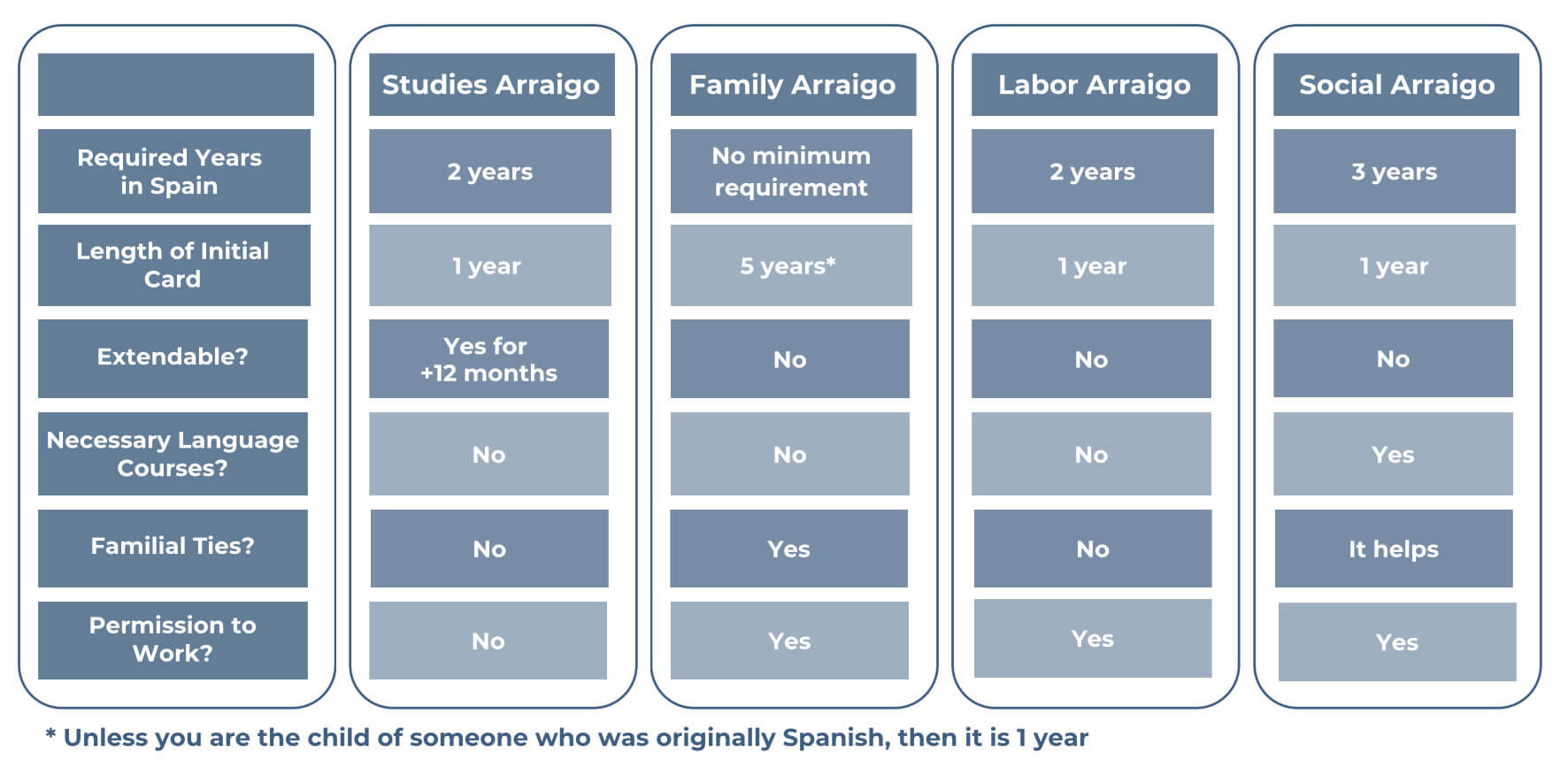
How long does the arraigo for training purposes last?
One of the key points of this arraigo is its duration.
Regardless of the initial duration of the training you enroll into, the initial residence authorization will be valid for 12 months.
That is to say, even if the course lasts 9 months, the authorization you will be granted initially will be for 12 months.
And what happens if the course I sign up for lasts more than 12 months?
The arraigo for training can be extended up to 2 years.
Hence, if the course lasts more than 1 year or you have not successfully passed all the content during the first year and you re-enroll for the next one; you can renew and extend the rooting for the training for an extra 12 months.
Or, as we will see below, instead of extending your arraigo, you can also modify it to a residence and work authorization.
You can read on for more information, or you can directly ask our expert immigration lawyers here:
Arraigo for formacion requirements
Like any other residence permit, you will need to fill out the designated application form (Modelo EX-10) and submit a valid passport (as well as a complete copy).
Then aside from these standard documents, in order to apply for this arraigo for training purposes, 3 basic requirements must be met.
2 years of continuous residence in Spain
In the first place, and as with any type of residence due to exceptional circumstances, it will be essential to demonstrate continuous residence in Spain. In this case during the 2 years prior to the application.
You can prove it through the city hall registration (“empadronamiento”) or with your passport.
Thus, it will be important that your departures from Spain do not exceed 90 days in total.
Criminal records
On the other hand, it will be necessary to demonstrate that you have no criminal records, in Spain nor in any other country in which you have been living during the last 5 years.
However, you will NOT have to present the criminal record certificate if you have recently submitted a residency application or if you have been in Spain for 5 years continuously.
Remember, as always, official documents from foreign countries, such as this one, must be translated and legally recognized in Spain.
Social integration report
You must also submit a report attesting to your integration in Spain. This report must be issued by the Autonomous Community where you reside. It typically consists of questions about your daily routine and your life in Spain.
Pursuant to Royal Decree 1155/2024, Instruction SEM 4/2025 establishes that this report is mandatory for the social and educational integration process.
You can continue reading for more information, or you can ask our attorneys who specialize in immigration law directly:
The course or studies
And, finally, the most important requirement and the one related to the studies. The foreigner must commit to:
- To carry out training for employment, and this training must be regulated
- To obtain an official certification of professional qualifications that is within the National Catalogue of Professional Qualifications in the field of labor administration
- To start training that allows her to obtain a technical aptitude certification
- To complete a professional qualification required to be able to work in a specific occupation
To be more specific, the foreigner must commit to one of the following types of courses:
- Post-compulsory secondary education
- Formal vocational training (including Level C vocational certificates under the
- Vocational Training System, specifically Levels 1, 2 and 3).
- Training organised by the Public Employment Services
- Adult education
You can access a complete guide on the requirements and list of courses valid for this type of arraigo here.
When applying for arraigo for studies, the foreigner does not have to have already started their studies, they simply have to commit to doing it in the near future. In all cases, the course must be part of the National Catalogue of Professional Qualifications.
After 3 months of having achieved this permit, enrollment must be proven to the Immigration Office.
If the enrollment does not take place within this period, there will be an obligation to notify the immigration office, and the arraigo will be extinguished.
The course can either be 100% in-person, or a hybrid of in-person and online.
If you need or wish to change your studies, you must ensure that it is possible at the nearest Immigration Office. Bear in mind that the new studies need to fall in one of the categories permitted (the ones we shared above)
You can find the list of valid centers and training courses in the following 2 links:
Valid studies for a arraigo para la formación
When you fill in and complete your application, you must select and include a course that is established in RD 1155/2024 and SEM 1/2025.
And you will do it through the model of responsible declaration that you can download here.
These 5 groups of valid training courses are:
Regulated Vocational Training
This includes vocational training, specialization courses, certificates of professionalism, and certificates of competence.
These are the Grade C vocational qualifications within the Vocational Training System, specifically Levels 1, 2 and 3.
These courses must be given by centers that are authorized by the Registry of Vocational Training Centers.
In some cases, some centers fall under the State Registry of Non-University Teaching Centers, so these must first be verified by authorities.
Post-compulsory secondary education
Some of the courses that count towards establishing roots through education in Spain are those in post-compulsory secondary education.
This group includes Bachillerato, intermediate-level vocational training, and intermediate-level arts and sports courses.
It is one of the most frequently enquired-about routes, particularly for those who arrived in Spain as minors and reach the age of majority whilst enrolled in ESO or starting Bachillerato: in these cases, continuing with Bachillerato studies can count as valid education for the social and educational integration requirement.
Training leading to technical aptitude certification or professional qualification
The second category is for training that is necessary for the exercise of a specific occupation.
Some examples include, training to obtain the Certificate of Professional Aptitude for driving land transport vehicles, training to qualify as railway personnel, and training to become a tower crane operator.
In the case of these courses, the training must be provided by an authorized center within the competent department.
Training promoted by the Public Employment Services (SEPE)
The next group is made up of courses that are promoted by the government itself.
This training must be included in the catalog of training activities, and must be given by entities registered in the State Register of Training Entities.
The procedure to enroll and apply for any of these courses works as follows:
- Applicants must register with the Public Employment Services once they have obtained their social integration status and their N.I.E.
- The training programme to be undertaken is scheduled and authorised.
- The course structure and program are published and scheduled so that the applicant may begin
Adult education
Face-to-face provision covering compulsory education within the adult education sector is also recognised.
This may include the categories of official master’s degrees and micro-credentials, although the criteria are now much more flexible.
Find your course here (listings)
Within the group of professional training courses (group 1 in the previous section), you can find the valid courses in the State Register of Non-University Teaching Centers (RCD), which divides the training courses by Autonomous Communities.
Click here to access this register
On the other hand, the SEPE portal also offers a search engine that will allow you to find certificates of professionalism by specialty or by professional occupation.
You can access the search engine here
Basically, we are talking about the eligible professional families are:
- Physical and Sports Activities
- Administration and Management
- Agrarian
- Graphic Arts
- Commerce and Marketing
- Building and Civil Works
- Electricity and Electronics
- Mechanical Manufacturing
- Hospitality and Tourism
- Personal Image
- Image and Sound
- Food Industries
- Extractive Industries
- Installation and Maintenance
- Wood, Furniture, and Cork
- Maritime and Fishing
- Chemical
- Health
- Safety and Environment
- Textile, Apparel and Leather
- Transport and vehicle maintenance
- Glass and Ceramics
Can I change my course under arraigo para la formación?
Yes, you can change your course under arraigo para la formación. It is possible to enrol in a course other than the one originally planned, provided that the new course meets the same requirements, that is to say, that it falls within one of the valid categories set out above.
We recommend that you consult the relevant Immigration Office before finalising the change, particularly if it involves switching to a different category of training.
Renewing or Modifying to the Work Permit
As we have just seen, the arraigo for training can be renewed (unlike the rest of the arraigos that require being modified to another type of residence directly).
But, we have even better news, once the studies are finished and the training is successfully completed, it will be possible to modify to a work permit for 2 years (renewable).
Thus, we see here how this arraigo has two phases. The individual will first have the residence to carry out the training, then after, the residence to work.
It is important to note here that, due to this, the arraigo for studies follows its own modification process. You can only modify to a work permit as an employee (also known as residencia por cuenta ajena).
The foreigner will have to find a job offer to be able to change his residence and start working for a company, and he will have to do it during the validity of the training arraigo (and never after).
The employment contract must guarantee the minimum salary; currently €1,134 gross per month. If the individual has multiple jobs, the sum of these jobs must amount to the said minimum wage.
You also need to demonstrate, through a certificate of achievement, that you have passed the course successfully.
Let us help you obtain your arraigo para la formación
As a conclusion, one of the great advantages of this arraigo is, without a doubt, that it will allow you to finally work in Spain and get your work permit.
As it is a rooting procedure, it may be complicated. Thus, if you have any questions or would like to receive personalized assistance, our expert lawyers are at your complete disposal.
Speak with one of our
immigration lawyers
Not sure which immigration pathway fits your situation? Our legal team will evaluate your case, recommend the best strategy, and handle the process from start to finish.